
Yogapedia
Western Yoga Information Resource & Guide
Information Architecture · Taxonomy Design · Usability Testing
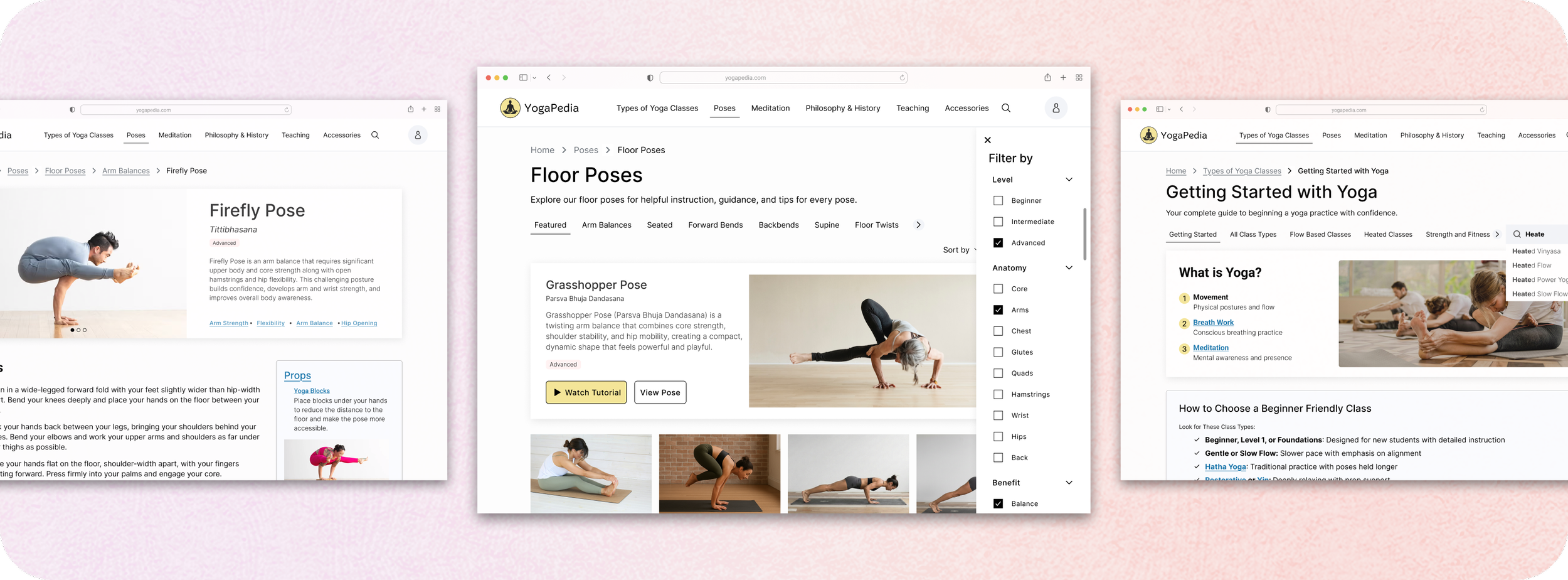
A comprehensive information architecture and taxonomy system for a Western yoga resource.
Yogapedia organizes the complex domain of Western yoga into clear, user friendly structures. I developed a domain model, structure map, and search/browse patterns to help users navigate yoga styles, poses, sequences, and related concepts. The final designs were iterated based on usability testing to improve findability, discoverability, and understandability.
Anticipated Impact
Bringing structure to how people explore Western yoga
Yogapedia is designed to help practitioners and teachers quickly find specific information (like a pose), while also supporting discovery.
Key Design Decisions
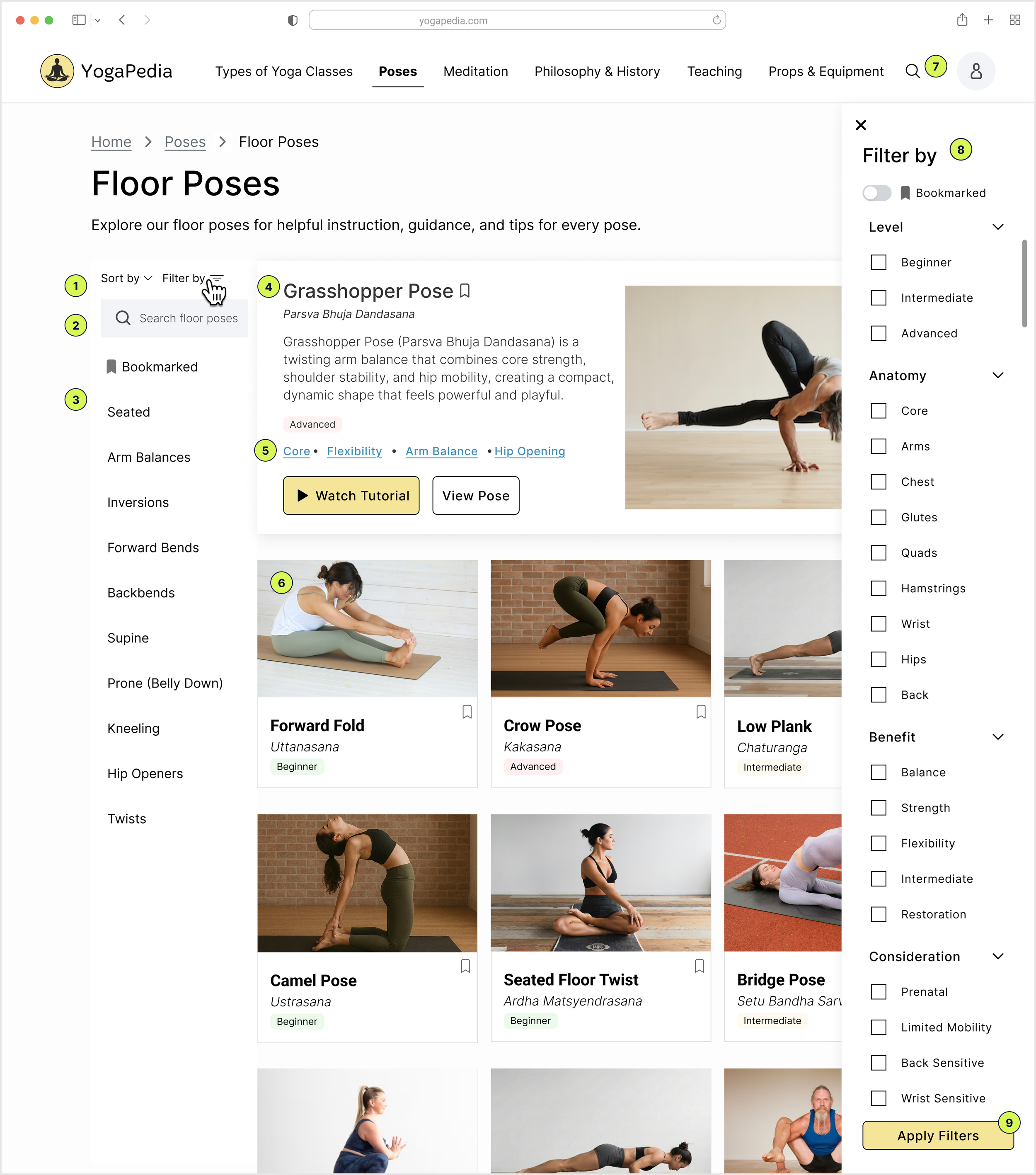
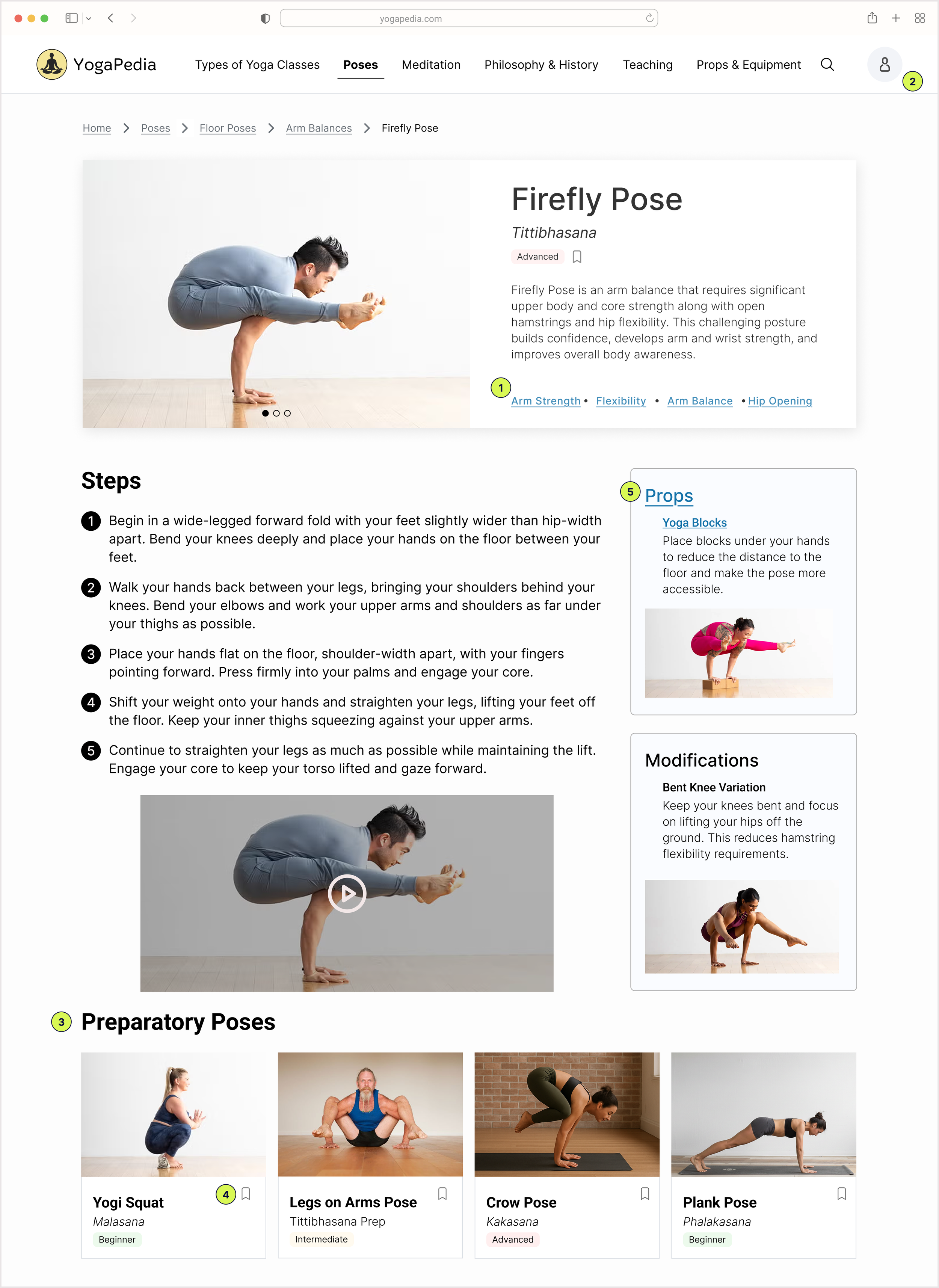
- Structured taxonomies via faceted filters, controlled vocabulary search, and clickable descriptive metadata.
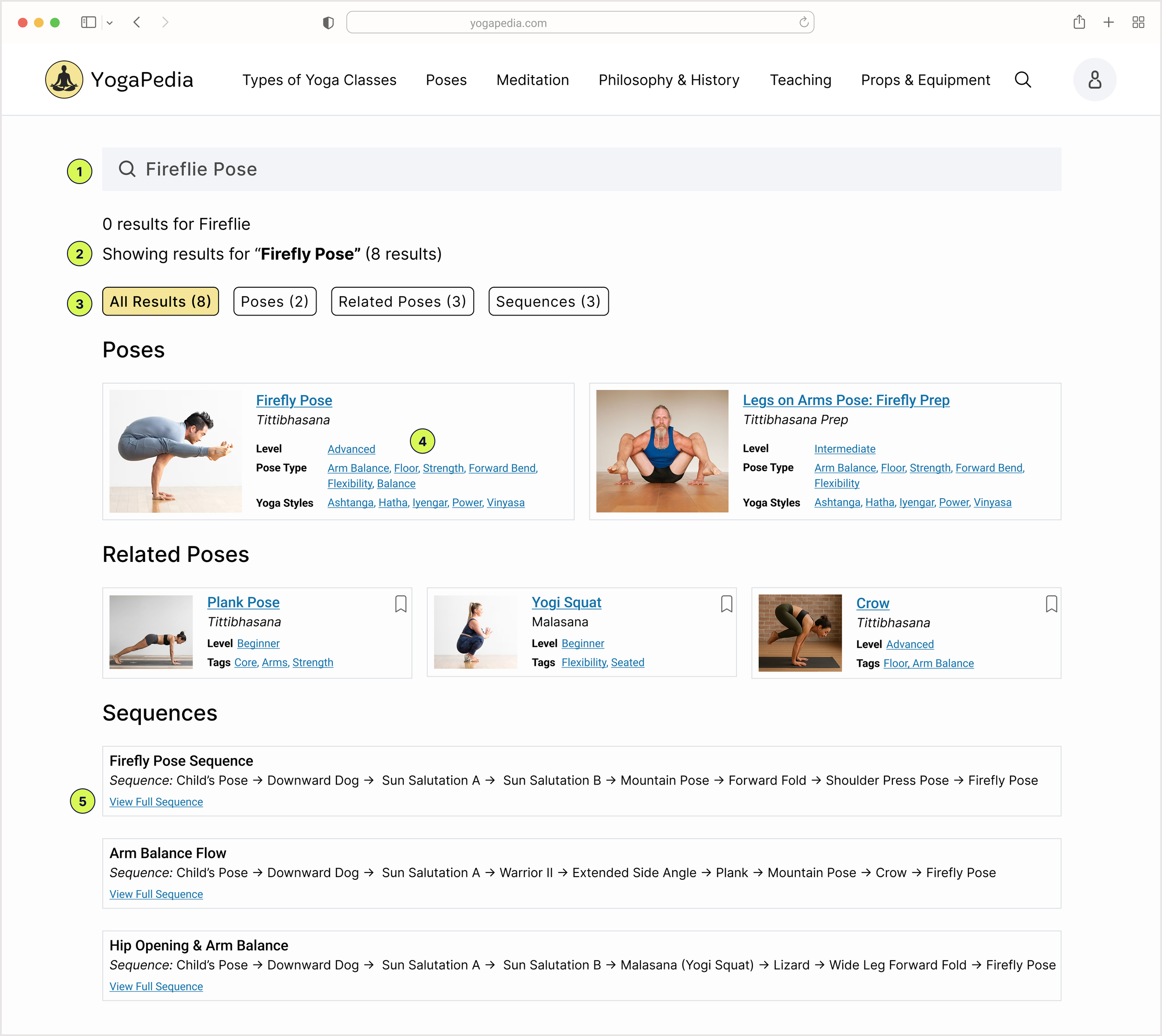
- Search safety nets with suggestions and autocorrection to guide users.
- Theme based class type grouping (e.g., Flow-Based, Heated) to improve findability.
Floor Poses Page
Users can browse poses through sorting by category, and using faceted filters.
Firefly Pose Page
The pose detail page supports discovery through contextual tags and related content.
Global Search Page
A site wide search experience designed with query reformulation.
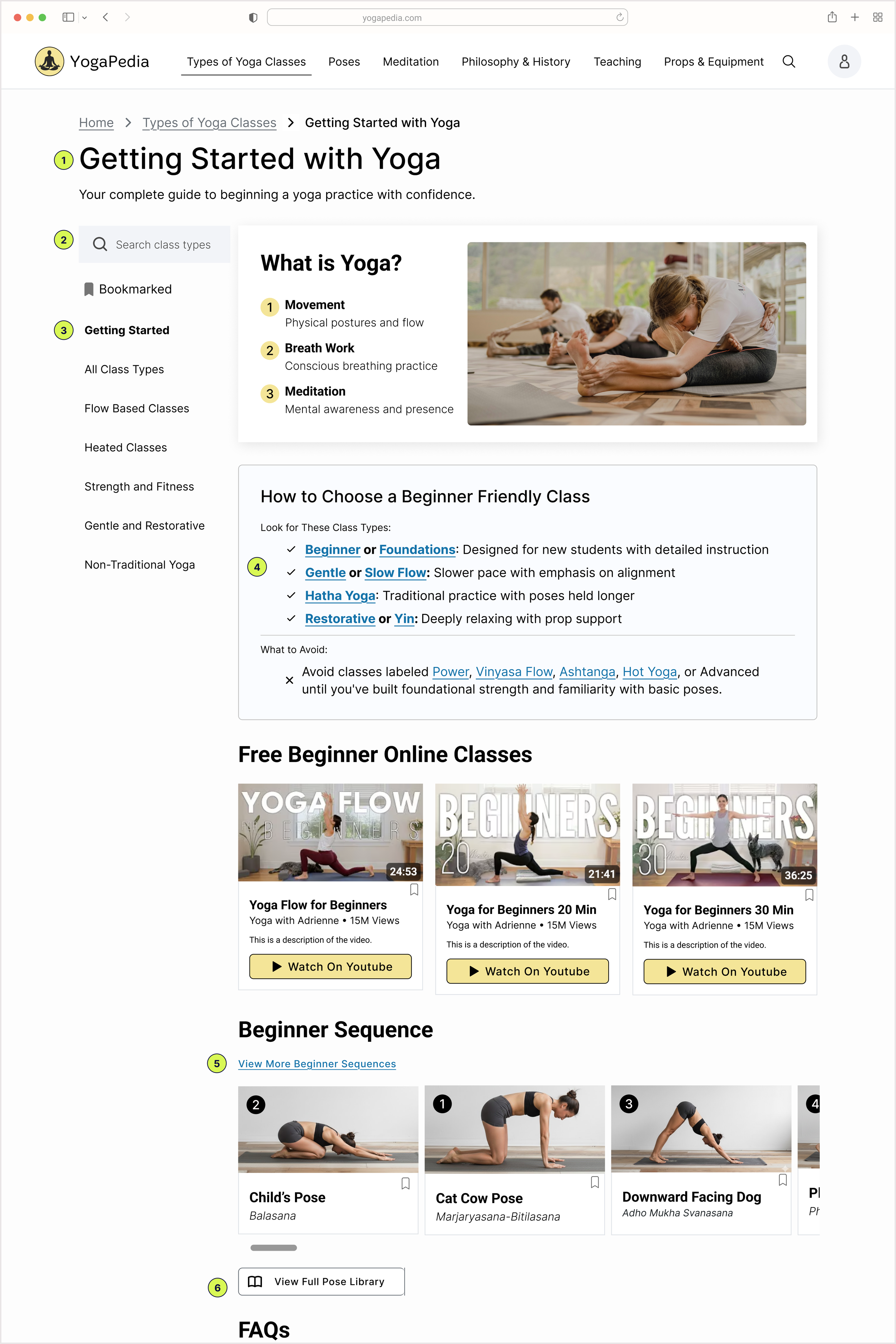
Getting Started with Yoga Page
A beginner focused page that encourages exploration through guided content sections, local navigation, and a controlled vocabulary search.
The designs above were developed through a deliberate process that combined domain research, taxonomy design, and usability testing to create the information architecture of the site. Here's the path I took:
- 1Domain expert interviews & domain model
- 2Open card sort
- 3Tree tests
- 4Structure map
- 5User flow
- 6Wireframe
- 7Evaluation & iteration
IA Lens
For this project, the focus was optimizing:
✦ Understanding the Domain
The first step was to get a good handle on the topic of Western Yoga. I interviewed three yoga teachers (avg. 7 years teaching experience). I coded transcripts for entities (nouns) and relationships to build a domain model.
✦ Creating the Site Structure
Card Sort: Understanding Mental Models
Once I felt that I had a handle on the domain of Western yoga, I ran an open card sort to understand how participants naturally group yoga concepts. The six participants were a combination of yoga teachers and practicioners. From the card sort, I used two signals to inform the structure map:
- The labels participants used
- The card groupings that had the highest agreement
Strongest label signal:
Highest agreement groupings:
These high consensus clusters helped validate which entities should be grouped together in the hierarchy.
- I used the highest agreement clusters to confirm which entities should share a parent category.
- I used participant labels (especially "Types of Yoga") to guide top level naming.
The First Structure Map
Using the card sort results as a guide, I created a structure map and then tested it with a tree test to measure findability using only labels + hierarchy (no UI). Participants were recruited from Reddit's r/yogateachers community. I specifically tested yoga teachers (instead of practitioners) because teachers are more likely to recognize these entities and understand semantic categorization.
| Task | Success | |
|---|---|---|
| Where would you find information about the benefits of Power Yoga? | 45.5% | |
| Where would you find information about what you can expect from a Yoga Sculpt class? | 50.0% |
The Second Structure Map
The first tree test showed friction in "class type" tasks. In v1, class types were organized around traditional categories (e.g., Hatha / Vinyasa). Because participants struggled with these findability tasks, I reorganized the class types into thematic groupings.
- Vinyasa ex: Power Yoga
- Hatha ex: Iyengar
- Hot Yoga ex: Bikram
- Restorative ex: Yin Yoga
- More ex: Yoga Sculpt
- Flow Based Classes ex: Power, Vinyasa
- Heated Classesex: Bikram
- Strength & Fitness ex: Yoga Sculpt, Power
- Gentle & Restorative ex: Yin Yoga
- Non Traditional ex: Aerial, Yoga Sculpt
After iterating the hierarchy and labels, I ran a second tree test to verify that findability improved and that changes didn't introduce new confusion elsewhere.
Final Structure Map
✦ Detailed Design
Defining the User Flow
With the structure validated, I translated the information hierarchy into a detailed user flow that models both: known item retrieval (finding a specific pose) and guided discovery (related concepts).
Wireframes and Components
The component design operationalizes the taxonomy through faceted navigation, controlled vocabulary search, descriptive metadata, and search safety nets (autocorrect + autosuggest).
✦ Evaluation and Next Steps
User Evaluation
A task based evaluation was performed on the final designs with three representative users. The aim of the tasks was to test for findability, discoverability, and understandability.
| Evaluation insight | Change made | |
|---|---|---|
| Users struggled to distinguish between global and local navigation. | Moved local navigation into a vertical left menu to clearly separate it from global navigation. | |
| Evaluators expected bookmarked content to be retrievable via filters. | Added bookmarks in local nav and as a facet filter to create multiple retrieval paths. |
Next Steps
- Create a prototype to be able to run more IA evaluation such as first click testing.
- Broader usability testing search and discovery.